
Why Healing Takes Time: Understanding the Body Beneath the Symptoms
One of the most common questions we get asked in the clinic is:
“How long will it take to feel better?”
The answer lies in understanding how the body actually works and this can be different for each person or even between their different ailments or complaints.
Summarize this article in ChatGPT
The Body Is Always Adapting
The body is constantly adapting. Long before you ever feel pain, it is compensating working hard to keep you in balance.
When the body isn’t healing, it is compensating, creating altered movement patterns and systemic adjustments to keep you functioning and in balance.
What often feels like a sudden onset of pain is rarely sudden at all. It’s the moment the body can no longer compensate. Think of the straw that broke the camel’s back.
By the time symptoms appear, the body has usually been working overtime for quite some time. Tissues may be strained, movement patterns less efficient, and the nervous system more reactive. The body is tired, is cant hold all these layers of compensation together anymore and it begins to signal this. Think that seemingly acute neck or back pain, that sore wrist that come and goes but now won’t go!
The Body Heals in Layers
Healing often unfolds in layers, much like an onion.
Our osteopaths are always looking for the cause of the complaint. What is fascinating is that as we work on what is most obviously causing the complaint and this layer begins to resolve, older deeper layers can show up and be part of the picture. Sometimes there’s a new pain or discomfort that arises and the client remembers it, it started long ago but then my back pain took over and I forgot about that pain in my knee.
That is by accident, the body was able to compensate for the knee but it made the back more vulnerable and now it looks like back pain, that is actually the result of a knee dysfunction long ago.
When one layer is addressed, it often reveals another layer of compensation. With each layer, compensatory patterns are resolved and healing can prevail.
We must remember, this process of healing reflects the body's innate intelligence. The body is always prioritizing health and balance and strives to keep you functioning until it can no longer.
What Healing Can Look Like
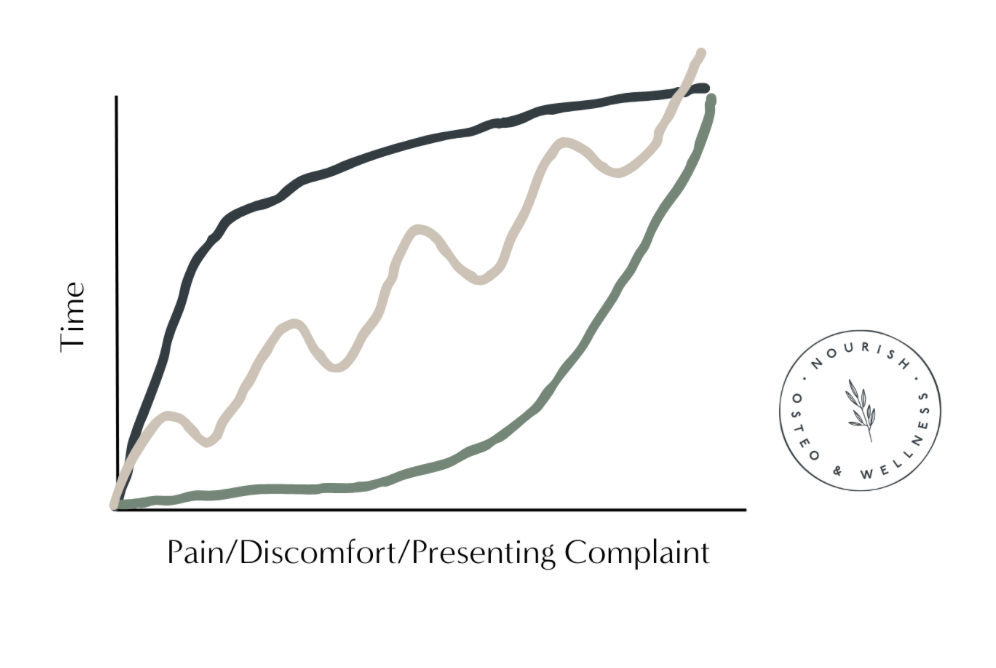
This layered process is why healing doesn’t always look the way we expect it to.
Black Line: Some people experience quick relief early on, followed by a more gradual resolution. This is often seen in more acute concerns where the body still has strong capacity.
Green Line: Others notice very little change at first. Progress can feel slow or subtle in the beginning, especially with longer-standing patterns. But over time, as deeper layers begin to shift, change can become more noticeable and even accelerate.
Brown Line: And for many, the process is not linear at all. There are ups and downs—periods of improvement followed by moments where symptoms return. This can feel discouraging, but it does not mean regression.
More often, it reflects another layer being accessed.
What matters is that each cycle still moves the system forward, even if it doesn’t feel that way in the moment.
Each of these patterns reflects a normal and valid healing process.
During your osteopathic treatment, your healing will land in one of these patterns. At Nourish we know that while we cant always give an exact timeline for healing, understanding the path you are walking to heal can be empowering!
If you are experiencing pain that won’t go away - get in touch and learn about the path you will walk to return to your best, pain free self!
We are here for you!
Get key takeaways with Chat GPT